TL;DR
- Match the plant to the window, not the other way around. Direction matters, but distance from the glass, outside obstructions, and direct sun hours matter just as much. (extension.illinois.edu)
- North-facing windows usually suit low-light foliage plants. East-facing windows are often the safest all-purpose choice for many houseplants. South-facing windows are the best natural fit for cacti, succulents, aloe, citrus, and most flowering plants. West-facing windows can work well, but afternoon heat is tougher on some plants. (gardens.si.edu)
- A bright room is not the same as a bright plant spot. Once you move several feet away from the window, the light category can change quickly. (extension.illinois.edu)
- If your apartment does not have a true high-light window, a small LED grow light can be cheaper than repeatedly replacing sun-loving plants. Using the EIA’s 2026 projected residential electricity price of 18.3 cents per kWh, a 20-watt light run 14 hours a day costs about $1.54 a month. (eia.gov)
In a small apartment, the expensive plant mistake is usually not watering. It is buying a plant for a window you do not actually have. Extension guidance consistently treats light as one of the main limiting factors indoors, and the difference between “on the sill,” “a few feet back,” and “across the room” can determine whether a plant holds steady or slowly declines. (extension.illinois.edu)
The budget is also essential. Buying replacement plants that die, buying the wrong decorative pot for an unsuitable location, or getting emergency lighting later can end up costing more than having a simple placement system from the beginning. The point is not to have every plant survive in every place, but rather to save the best natural light for those plants that require it and to put plants that do well in low-light in their proper low-light spot.
Use the 4D Window Match Score
Here is a simple framework that works well in a small apartment: score the actual plant spot, not just the room. Call it the 4D Window Match Score: Direction, Distance, Diffusion, and Direct sun. It draws on extension guidance that treats south windows as the strongest natural light, north windows as the weakest, and shows how distance and obstructions can quickly downgrade a spot that looks promising at first glance. (extension.oregonstate.edu)
| Factor | 0 points | 1 point | 2 points | 3 points |
|---|---|---|---|---|
| Direction | North | East | West | South or southwest |
| Distance from glass | More than 6 feet away or around a corner | 3 to 6 feet away | 1 to 3 feet away | On the sill or within 1 foot |
| Diffusion or blockers | Heavy blinds, deep overhang, close building, dense tree shade | Partial blockage for part of the day | Sheer curtain or light outdoor shade | Little to no obstruction |
| Direct sun | None | Less than 2 hours | 2 to 4 hours | 4 to 6 or more hours |
Categorize the amount of light received as follows: 0-5 points correspond to low light, 6-8 points to medium light, 9-10 points to bright indirect light, and 11-12 points are high light/direct light. This is not an exact science but it serves a valuable function by alerting users to two potentially overlooked factors: the distance between the plant and the window and whether the window is obstructed.
What each window is actually good for
Direction is your starting point, not your final answer. Still, in a small apartment, it is the fastest first cut. If you do nothing else, classify each window below before you buy another plant. (extension.oregonstate.edu)
| Window exposure | Typical light pattern | Good plant matches | Risky matches | Best small-apartment use |
|---|---|---|---|---|
| North-facing | Usually low light and little to no direct sun | Pothos, philodendron, snake plant, ZZ plant, aglaonema, peace lily | Cacti, aloe, citrus, most flowering plants | Use for reliable foliage plants and keep them fairly close to the window |
| East-facing | Gentler morning sun; often medium light | Spider plant, peperomia, dracaena, many foliage plants, some orchids | True desert succulents if placed too far back | Best all-purpose window for mixed collections |
| West-facing | Medium to bright light with hotter afternoon sun | Monstera, rubber plant, spider plant, some succulents if close and acclimated | Shade-loving plants pressed against hot glass | Useful if you monitor heat, dryness, and summer scorch |
| South-facing | Brightest natural light; can provide 4 to 6 hours of direct sun | Cacti, succulents, aloe, citrus, most flowering plants | Low-light plants placed right against the glass in peak summer | Reserve this window for plants that really need the strongest light |
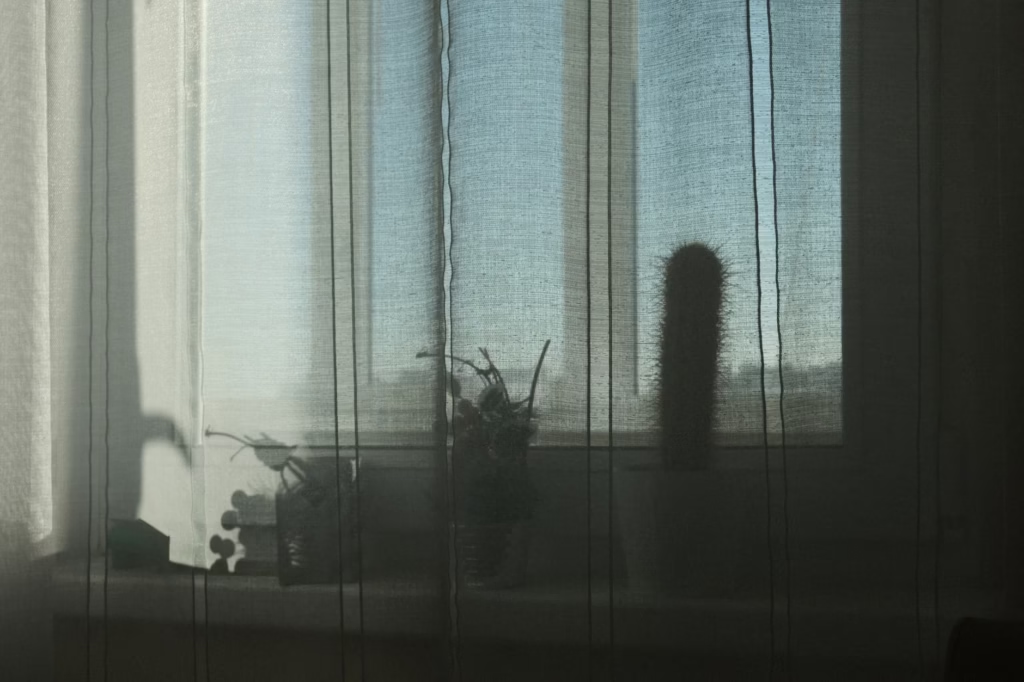
Low light is not no light. UMN describes low light as still bright enough to read a newspaper, and Smithsonian notes there is no true houseplant for a dark closet. (extension.umn.edu)
A realistic small-apartment example
Consider a 550-square-foot one-bedroom with three windows: a north bedroom window, an east kitchen window, and a west living-room window partly blocked by the next building. The reader wants four plants and has an $80 plant budget. Use illustrative local nursery prices: pothos $18, snake plant $24, small monstera $28, and aloe $14. The question is not whether all four are attractive. It is whether the apartment can light all four without extra gear.
- East kitchen sill: Direction 1, Distance 3, Diffusion 3, Direct sun 2 = 9 points. That is a bright-indirect spot. It is the best natural place for the monstera because medium-light plants often do well in east exposure, and many foliage plants handle filtered or indirect light there. (extension.umn.edu)
- North bedroom stand 2 feet from glass: Direction 0, Distance 2, Diffusion 3, Direct sun 0 = 5 points. Treat it as low light. That is a good home for the pothos or snake plant, not the aloe. (extension.illinois.edu)
- West living-room shelf 6 feet back and partly blocked: Direction 2, Distance 0, Diffusion 1, Direct sun 0 = 3 points. Even though it is a west window, the shelf behaves like low light. This is where apartment owners get fooled by a bright room. (extension.illinois.edu)
- Aloe: no natural spot scores high enough to make it an easy choice. The cheapest move may be to skip it and buy another low- or medium-light plant. If aloe is non-negotiable, budget for supplemental light instead of hoping a weak window will behave like a south window. (extension.umd.edu)
This is where the money decision gets clearer. If you buy the aloe anyway and lose two $14 plants over time, you have spent $28 and still do not have a solution. A 20-watt LED run 14 hours a day costs about $1.54 a month, or about $18.70 a year, using the EIA’s 2026 projected residential electricity price of 18.3 cents per kWh. (eia.gov)
The law is simple: if you merely want plants, buy plants that suit your lighting situation and do not spend any money on equipment. Nonetheless, if you specifically want sun plants, light should be an expense that you include in your budget right from the start.
A 20-minute placement routine before you buy anything
- Label each window north, east, west, or south. If you rent, do this once and save it in your phone.
- Check each window twice in one day: late morning and late afternoon. Note any direct sun and anything that blocks it, such as a balcony, tree canopy, neighboring building, or heavy blind. (extension.umn.edu)
- Score the exact plant spot with the 4D Window Match Score. A bookcase across from the window is its own light zone. Do not grade the whole room. (extension.illinois.edu)
- Sort your plant wish list into three buckets: low light, medium light, and high or direct light. Put your highest-light plant in the best natural window first, then fill the lower-light spots. (gardens.si.edu)
- If a plant only works with artificial light, decide that before checkout. That is a planned cost, not a plant rescue.
- Adjust watering to the light, not the label alone. UMN notes that plants in lower light grow more slowly and use less water, while brighter, warmer spots dry faster. (extension.umn.edu)
Common mistakes that waste money and plants
- Calling a room bright when the plant is actually far from the window. Missouri Extension notes that average room light away from windows is not bright enough for most flowering plants. (extension.missouri.edu)
- Buying for the photo, not the exposure. A cactus on a low-light shelf is still a cactus with high-light needs. (extension.umd.edu)
- Trying to fix bad light with more water, more fertilizer, or a bigger pot. Missouri is explicit that the effects of insufficient light are not cured by extra fertilizer, water, or repotting. (extension.missouri.edu)
- Moving a shade-tolerant plant straight into hard sun. Abrupt moves to more intense light can bleach or burn foliage, and spring sun can scorch leaves if the transition is too fast. (extension.missouri.edu)
- Ignoring temperature stress at the glass. Oregon State advises keeping leaves off cold windows, and Missouri warns against hot air registers or radiators directly below a plant. (extension.oregonstate.edu)
- Watering on a fixed calendar. Light, temperature, pot size, and humidity all affect how fast soil dries. (extension.missouri.edu)
When your apartment still does not have the right window
Sometimes the honest answer is that the apartment is the limit. Deep floor plans, heavy exterior shade, overhangs, tinted glass, or a neighboring wall can strip a lot of usable light from what should have been a good exposure. UMN notes that overhangs can block part of the day, and Maryland notes that houseplants can fail after a healthy start because indoor light is inadequate. (extension.umn.edu)
- First backup: move the plant closer, not just prettier. Illinois shows that even a south window can shift from direct to lower categories as distance increases. (extension.illinois.edu)
- Second backup: add one targeted LED instead of buying several replacement plants. UMN recommends timers for supplemental light and suggests 12 to 14 total light hours for foliage houseplants and 14 to 16 for flowering houseplants. (extension.umn.edu)
- Third backup: keep the collection aligned with the apartment. If your only reliable light is low to medium, lean into pothos, philodendron, snake plant, spider plant, peperomia, and similar foliage plants instead of forcing a desert-plant collection. (gardens.si.edu)
- Fourth backup: make seasonal changes gradually. As spring light strengthens, move plants closer over one to two weeks rather than all at once. (extension.umn.edu)
How to pressure-test your setup in 30 days
Do not evaluate the placement based on the first week; rather assess it after a month. A label, a gardening store, and your eyes may mislead you. Usually new growth reveals the truth quicker than anything else.
- If stems stretch, leaves get smaller, or the plant leans hard toward the glass, suspect insufficient light first. Extension sources describe spindly or leggy growth as a common low-light response. (extension.umd.edu)
- If leaves show pale patches or crispy edges after a move, you likely increased light too quickly. Back the plant off slightly and acclimate more slowly. (extension.umn.edu)
- If a supposed high-light plant stays wet for long periods, the spot may be dimmer than you think. Brighter, warmer spots usually dry faster. (extension.umn.edu)
- If overall growth is weak or yellowing, check light and watering before fertilizer. Missouri notes that the same symptoms can come from poor light or overwatering. (extension.missouri.edu)
- Rotate only enough to keep growth even. Missouri suggests turning plants about once a week if they are becoming one-sided. (extension.missouri.edu)
Note: Plant prices in this article are illustrative, and electricity costs vary by utility. For a more personal estimate, swap your own kWh rate into the grow-light math. The method matters more than the exact dollar figure. (eia.gov)
Bottom line
In a small apartment, the right plant window is usually decided before you bring the plant home. North windows are for tolerant foliage plants. East windows are the safest general-use choice. South windows should be reserved for plants that truly need strong light. West windows can be productive, but they need more heat management. If a plant does not match your existing light, either budget for a grow light from day one or buy a different plant. That single choice can save more money and frustration than any fertilizer, misting routine, or decorative upgrade. (gardens.si.edu)
FAQ
Is a north-facing window ever enough for a Monstera?
Sometimes, but only if the plant is very close to the window and the view is not heavily blocked. WVU classifies Monstera as a medium-light plant, while north windows are generally better suited to lower-light foliage plants. (extension.wvu.edu)
Can I keep a plant across the room from a sunny window?
For many plants, no. Missouri notes that average room light away from windows is not bright enough for most flowering plants, and Illinois shows that light categories drop with distance from the window. (extension.missouri.edu)
Do sheer curtains make a south window useless?
Usually not. Sheer curtains often turn harsh direct sun into filtered or bright indirect light, which can be ideal for many medium-light houseplants. (gardens.si.edu)
When does a grow light make financial sense?
When you are committed to a high-light plant that your apartment cannot naturally support. At the EIA’s 2026 projected residential electricity price, a 20-watt LED used 14 hours a day costs about $1.54 a month, which can be cheaper than replacing failed sun plants over time. (eia.gov)
Should I rotate all houseplants every week?
Not all, but rotation can help window plants grow more evenly. Missouri suggests turning plants about once a week when they are becoming one-sided. (extension.missouri.edu)
References
- Illinois Extension – Lighting | Houseplants – https://extension.illinois.edu/houseplants/lighting
- University of Minnesota Extension – Lighting for indoor plants and starting seeds – https://extension.umn.edu/planting-and-growing-guides/lighting-indoor-plants
- University of Maryland Extension – Lighting for Indoor Plants – https://www.extension.umd.edu/resource/lighting-indoor-plants
- Smithsonian Gardens – Houseplant Care – https://gardens.si.edu/learn/educational-resources/plant-care-sheets/houseplant-care/
- West Virginia University Extension – Common Houseplant Care – https://extension.wvu.edu/lawn-gardening-pests/indoor-plants/common-houseplant-care
- Oregon State Extension – Set houseplants up for success: right plant, right place – https://extension.oregonstate.edu/es/node/135096/printable/print
- University of Missouri Extension – Caring for Houseplants – https://extension.missouri.edu/publications/g6510
- U.S. Energy Information Administration – Short-Term Energy Outlook – https://www.eia.gov/outlooks/steo/report/elec_coal_renew.php?sfnsn=mo