TL;DR
- Your eyes are not reliable light meters. Extension sources note that people adapt quickly to indoor brightness, so two spots that look similar can differ sharply for plant growth. (gardeningsolutions.ifas.ufl.edu)
- A practical no-cost test uses five clues: direct sun, shadow quality, window direction, distance from the glass, and outside or inside obstructions. That is the basis of the SHADE-15 score in this article. (extension.umd.edu)
- Many extension guides place low indoor light at roughly 25 to 100 foot-candles, or about 269 to 1,076 lux, though exact bands vary by source. (extension.umd.edu)
- If a spot scores as truly dim, the money-saving move is to change the placement plan before you keep replacing stressed plants. Some very dark areas simply are not plant spaces without supplemental light. (extension.msstate.edu)
The costly error is often not the light meter device but purchasing one plant after another for a spot where there was never enough light. In that case, it’s important to remember that low light is a relative term when it comes to apartments. A term used to refer to many situations where there is no sufficient light.
You can get close enough without buying special equipment. The goal is not a lab-grade reading. The goal is to sort each plant spot into a useful category: genuinely low light, medium light, or bright enough that a “low-light” plant is only surviving there by reputation. Extension guidance supports using window direction, distance, shadow quality, and plant response as practical clues when you do not have a dedicated meter. (extension.umd.edu)
Important limit: Houseplant light ranges are approximate, and different university sources use slightly different cutoffs. Iowa State also notes that lux and foot-candles are based on human vision, so they are helpful for apartment decisions but not the most exact plant-specific measure. That is why a practical audit beats obsessing over one exact number. (content.ces.ncsu.edu)
What “low light” actually means indoors
University of Maryland Extension defines low light at 25 to 100 foot-candles, medium-bright light at 100 to 500, high light at 500 to 1,000, and direct indoor sun above 1,000 foot-candles. UF/IFAS uses very similar bands and explains why people misread them: our eyes adjust so well indoors that “bright” is often just a feeling, not a useful plant category. (extension.umd.edu)
That matters because low light is not the same as no light. Minnesota Extension describes low light as the kind of spot where you can still read easily, but it also notes that most low-light plants are foliage plants, not heavy bloomers. Iowa State adds that even plants that tolerate low light usually look best in bright indirect light. In other words, “tolerates low light” often means “will not die quickly,” not “this is the ideal long-term location.” (extension.umn.edu)
| Light label | Approx. brightness | What the spot usually looks like | Typical plant fit |
|---|---|---|---|
| Low light | 25-100 fc / 269-1,076 lux | No direct sun; often a north window, an artificially lit room, or a spot set well back from the glass | ZZ plant, snake plant, peace lily, pothos |
| Medium light | 100-500 fc / 1,076-5,380 lux | Bright room, usually near an east or west window, but no hard direct sun on leaves | Chinese evergreen, rubber plant, African violet |
| High light | 500-1,000 fc / 5,380-10,760 lux | Close to a south window or some west windows; may get some softened direct sun | Jade, hoya, croton |
| Direct indoor sun | Over 1,000 fc / over 10,760 lux | At least several hours of direct sun hitting the plant | Cacti, succulents, citrus |
Use the SHADE-15 apartment light audit
Here is the original tool for this article: the SHADE-15 score. It is not an official horticulture scale. It is an editorial shortcut built from extension guidance on direct sun, shadow quality, window direction, distance, and obstructions. Score each plant spot from 0 to 15. The lower the number, the more likely you are dealing with true low light or even decorative-only darkness. (extension.umd.edu)
- S – Sun hours. Score 0 if the spot gets no direct sun on the leaves, 1 for less than 1 hour, 2 for 1 to 3 hours, and 3 for 4 or more hours. Extension guidance treats several hours of direct indoor sun as a separate high-light condition. (gardeningsolutions.ifas.ufl.edu)
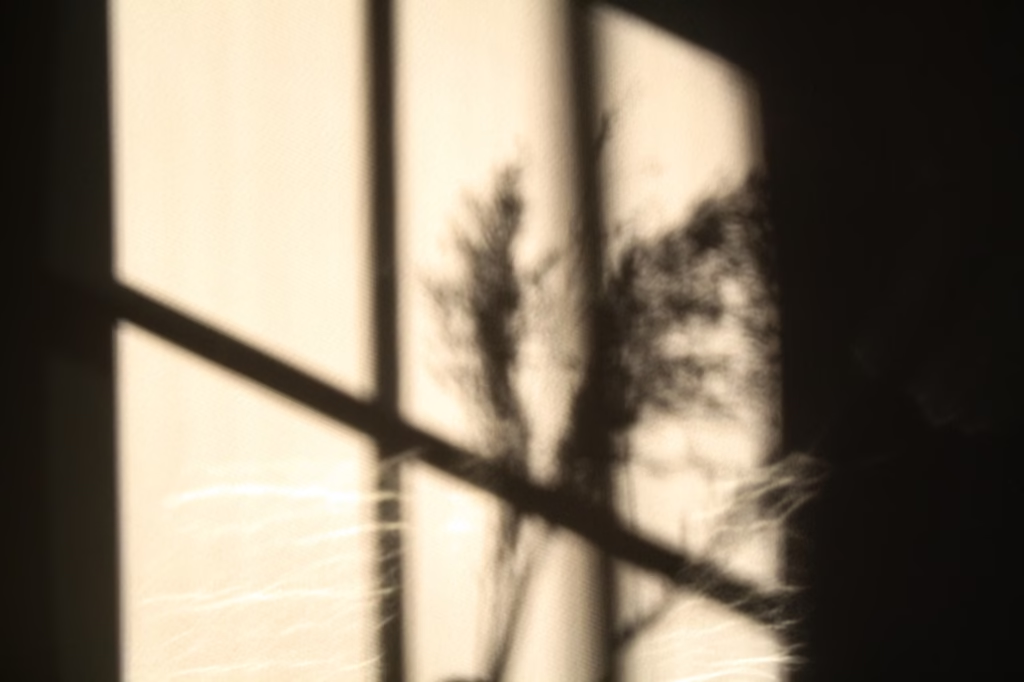
- H – Hand shadow. Hold your hand between the window and the wall or floor at the brightest part of the day. Score 0 for no real shadow, 1 for a vague blur, 2 for a distinct shadow, and 3 for a crisp-edged shadow or a sunbeam hitting the spot. Iowa State describes bright indirect light as strong enough to cast a distinct shadow. (yardandgarden.extension.iastate.edu)
- A – Angle of the window. Score 0 for a windowless room, 1 for north exposure, 2 for east or west, and 3 for south or a very bright west exposure. Maryland and other extension sources consistently rank north lower and south higher for indoor light. (extension.umd.edu)
- D – Distance from the glass. Score 0 for more than 10 feet back, 1 for 5 to 10 feet, 2 for 2 to 5 feet, and 3 for within about 2 feet or directly in front of the window. Extension guidance repeatedly notes that intensity drops fast with distance, and dim areas more than 8 to 10 feet from windows are hard for many plants. (extension.illinois.edu)
- E – External blockers. Score 0 if heavy blinds, awnings, a porch, deep overhangs, nearby buildings, or dense trees block the window for most of the day; 1 for a sheer curtain or moderate blockage; 2 for minor blockage; 3 for a clear, unshaded window. Extension sources say both window coverings and outside structures can sharply reduce available light. (yardandgarden.extension.iastate.edu)
Use the total this way: 0 to 5 is very low and often risky for anything except the toughest foliage plants; 6 to 8 is workable low light; 9 to 11 is medium; 12 to 15 is bright to high light. Those bands are meant for placement decisions, not as a conversion chart to exact foot-candles. If you are between scores, trust the lower one unless the plant gets obvious direct sun. (gardeningsolutions.ifas.ufl.edu)
How to run the audit in one weekend
- Pick the exact spots where a plant might live. A windowsill and a shelf six feet back are two different light environments.
- Test on a reasonably bright day if you can. If the weather is gloomy, repeat the check on the next clear day before you make a final call.
- Check each spot three times: morning, around midday, and late afternoon. Write down whether direct sun hits the leaves and what the shadow looks like.
- Measure distance with what you already have: floor tiles, a tape measure, or even your own foot length if you need a rough estimate.
- Score the spot with SHADE-15, then label it on paper or in your phone as very low, low, medium, or bright.
- Recheck the same spot in January and again in June if your apartment has major seasonal shifts, nearby trees, or heavy winter cloud cover.
A realistic apartment example
Imagine a one-bedroom apartment with two possible plant spots. Spot A is a bookshelf 9 feet from a north-facing window behind a sheer curtain. It gets no direct sun, shows only a weak shadow at 1 p.m., and faces a neighboring wall. Its SHADE-15 score is 0 for sun, 1 for shadow, 1 for angle, 1 for distance, and 1 for blockers, for a total of 4. That is very low light. Spot B is a side table 3 feet from an unshaded west window. It gets about 2 hours of late sun and throws a distinct shadow. Its score is 2, 2, 2, 2, and 3, for a total of 11. That is solid medium light. (extension.umd.edu)
The decision is straightforward. Spot A is where you might try a snake plant, pothos, peace lily, cast-iron plant, or ZZ plant, and you should expect slower growth. Spot B is better reserved for plants that want more energy. The financial lesson is simple: if you put a medium-light plant in Spot A because the room “looked bright,” you may end up paying for the same lesson twice. (extension.umd.edu)
Common mistakes that make apartments seem brighter than they are
- Judging with your eyes after you have been in the room for a while. UF/IFAS specifically warns that human eyes adapt too well to compare indoor light accurately. (gardeningsolutions.ifas.ufl.edu)
- Using window direction alone. North, east, west, and south matter, but distance from the glass changes the result quickly. (extension.umd.edu)
- Ignoring curtains, insect screens, porches, overhangs, trees, or the building next door. Those obstructions can materially reduce available light. (yardandgarden.extension.iastate.edu)
- Testing only once. Minnesota and other extension sources note that seasonal changes can turn a barely usable winter spot into a decent spring one, or the reverse once outdoor trees leaf out. (extension.umn.edu)
- Assuming a “low-light” plant will flower or stay compact in a dim corner. Low-light plants are often foliage plants first, and weak light can mean slower growth, stretching, or lack of blooms. (extension.umn.edu)
- Treating a phone app as truth. UF/IFAS says phone-based readings can be good enough for approximations and change-tracking, but accuracy varies by device and method. (gardeningsolutions.ifas.ufl.edu)
When the room fails the test
Sometimes the audit gives you an answer you do not want: the corner is not low light, it is too dark. Mississippi State notes that below about 50 foot-candles, plant life usually does not last long. It also says dim spots more than 8 to 10 feet from windows are difficult for many plants. That is useful information. It tells you to stop shopping for a miracle plant and change the plan. (extension.msstate.edu)
Start with the free fixes. Move the plant closer to the glass. Open the blinds earlier. Shift from a shelf to a stand. Wipe dusty leaves so the plant can use the light it gets. If you insist on using a dim decorative spot, Mississippi State suggests rotating plants back to better light for 4 to 8 weeks so they can recover. If none of that works, the honest backup options are either choosing a truly tolerant plant or admitting the space needs supplemental light. A phone app you already own can help compare spots, but use it only as a rough relative check. (extension.msstate.edu)
How to verify your conclusion before you rearrange the whole apartment
- Take a photo of the plant in the test spot on day 1 and again two to three weeks later.
- Watch the new growth, not just the old leaves. Pale, stretched, slow, or lopsided growth can point to weak light; leaf drop and failure to bloom can also be clues. (yardandgarden.extension.iastate.edu)
- If leaves bleach, crisp, or scorch, the spot may be too intense, or the plant may have been moved too quickly into stronger sun. (yardandgarden.extension.iastate.edu)
- Re-score the spot when the season changes, especially after trees leaf out in spring or when winter sun angles shift.
Bottom line
If you want a no-cost way to measure low light in an apartment, do not start with gadgets. Start with the window, the distance, the shadow, the blockers, and the number of hours of direct sun. The SHADE-15 audit will not replace a dedicated meter, but it is practical enough to help you avoid the most common money-wasting mistake: buying plants for spaces that only look bright to human eyes. (gardeningsolutions.ifas.ufl.edu)
FAQ
Is a north-facing window always low light?
Usually, yes, especially compared with south-facing exposures. University of Maryland lists north windows in the low-light group, but the final result still depends on distance from the glass, window size, and obstructions. A big unobstructed north window can be usable for low-light plants, while a shelf several feet back can be much dimmer. (extension.umd.edu)
Can I trust a phone light app if I already have one?
Use it for comparison, not certainty. UF/IFAS says phone apps can be good enough to track changes between spots, but their accuracy varies by device and method. If one corner reads consistently much lower than the windowsill, that difference is useful even if the absolute number is not perfect. (gardeningsolutions.ifas.ufl.edu)
How far from the window is usually too far for a plant?
There is no single cutoff, but extension guidance says light drops quickly as you move away from the glass. Mississippi State says dim areas more than 8 to 10 feet from windows are difficult for many plants, while Illinois shows that even a south-window room can fall into low light far back from the window. (extension.msstate.edu)
Which plants are the safest bets after a low-light result?
Reliable low-light examples from extension sources include ZZ plant, snake plant, peace lily, pothos, cast-iron plant, philodendron, and Chinese evergreen. They are usually better choices for a true low-light apartment spot than succulents or blooming plants that want stronger light. (extension.umd.edu)
Does overhead apartment lighting count?
It counts, but usually as a weaker source unless it is on for long periods and the plant is matched to that setting. Maryland includes some artificially lit rooms in the low-light range, and Minnesota notes that low- and medium-light plants can do well in fluorescent-lit spaces like offices. That is still very different from saying any overhead bulb can replace a good window. (extension.umd.edu)
References
- University of Maryland Extension: Lighting for Indoor Plants – https://www.extension.umd.edu/resource/lighting-indoor-plants
- UF/IFAS Gardening Solutions: Light for Houseplants – https://gardeningsolutions.ifas.ufl.edu/plants/houseplants/light-for-houseplants/
- Iowa State Yard and Garden: How to Care for Houseplants – https://yardandgarden.extension.iastate.edu/how-to/how-care-houseplants
- Illinois Extension: Lighting – https://extension.illinois.edu/houseplants/lighting
- University of Minnesota Extension: Lighting for Indoor Plants and Starting Seeds – https://extension.umn.edu/planting-and-growing-guides/lighting-indoor-plants
- Mississippi State University Extension: Care & Selection of Indoor Plants – https://extension.msstate.edu/publications/care-selection-indoor-plants
- University of Minnesota Extension: Spring Houseplant Care – https://extension.umn.edu/houseplants/spring-houseplant-care