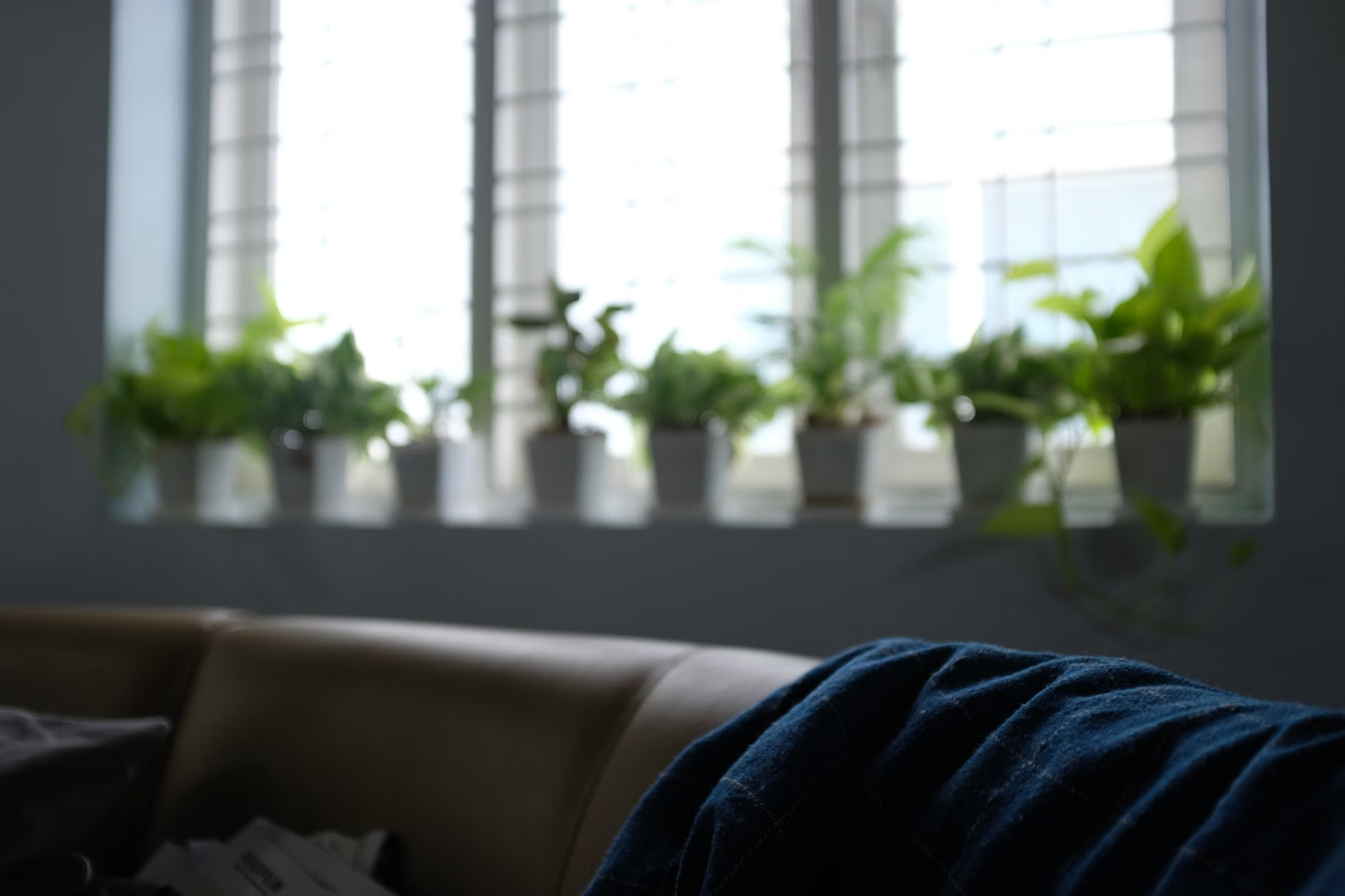
Definition of Bright Indirect Light Indoors
Bright Indirect Light is a phrase coined by people using indoor (plants) only and as such is not a recognized standard of lighting. The University Extension has provided insight into the confusion around light and why our eyes may perceive two different levels of light to be bright. (source)
1 Visual Test (Helpful, Not Definitive)
- Indirect: No clear definition of ‘limitless’ rectangle of light on the floor or silhouette created by the sunlight above, there may appear to be soft edges (or blurred) around the shadow.
- Bright: Able to read at a ‘comfortable’ distance (1 meter) and the ‘inside corner’ area does not feel like bright light was present.
- If sunlight strikes the leaves of a plant for part of the day, it does not have ‘indirect’ light for that period, even if later the light becomes indirect.
2 Basic Information About Lux and How to Convert Lux to Foot Candle (fc)
The measurement of lux (lx) is the measurement of light intensity of an illuminated surface (visible light on an illuminated surface). When applied to light inside an apartment this is a convenient way to calculate total amount of light for an area with the use of a lux meter (or smartphone) however it is still a ‘human visual metric’ not a uniquely ideal metric for plants as plants only use photosynthetically-active radiation (PAR)/PPFD.
In most instances where you read directions on how to provide lighting to plants in foot-candles (fc) you may make the conversion: 1 fc = 10.764 lux. (Data for this content was collected from the NCAA and various teams and sources prior to October 2023.)
| Plant-Care Term (informal) | Foot-Candles (FC) | Lux (Approx.) | What It Often Looks Like in an Apartment |
|---|---|---|---|
| Low Light | 25-100 FC | 270-1080 LUX | Far Away from Windows, Mostly Reflected Light, Are Fine for “Tolerate Low Light” Type of Plants, and Grow Very Slowly Too |
| Medium-Light | 100-500 FC | 1080-5380 LUX | Near a Window Usually without Any Direct Sun and Other Bright Indirect Spots Usually Live Here |
| High Light (Usually Still Indirect, If Diffused) | 500-1000 FC | 5380-10760 LUX | Very Near a Window May Have Filtered Light Since They Are High-Light Plants and Sheer or From Dappled Daylight Outside |
| Direct Sun (at Least Part Time) | ~1500 FC and Above | ~16,000+ LUX | Sunbeam on area being viewed, Very High in Heat and Clearly Defined Shadows, Will Need to be Accustomed to Many Houseplants in this Area |
The data presented above reflects widely-used extension guides to determine what indoor light will look like for plants grown inside. These bands are intended as guides only and should not be interpreted as guarantees of what any window is capable of providing for plants. (source)
A Practical Definition of “Bright Indirect Light,” Measured in Lux
Due to the extensive usage of “bright indirect” to describe plant light levels, you can consider it in two bands for clarity and convenience within your apartment:
- Minimum Bright Indirect Light: 1,500-3,000 Lux (most varieties survive and continue growing slowly).
- Maximum Bright Indirect Light: 3,000-10,000 Lux (many highly-variegated types thrive and grow quickly).
If you consistently receive less than ~500-1,000 lux at your spot for most parts of the day, you’re generally in medium to low illumination indoors, regardless of how bright it appears to your eyes.
Lux levels according to direction of window (N/E/S/W) and distance from glass
The direction of the window impacts (1) the time of peak light, and (2) the management of glare/direct sunlight risk. If the window faces east/west, there are bright spikes in the early/late parts of the day, but glare may make the space less usable. North-facing offers more stable, less intense daylight. (source)
| Window Orientation | Time of Day When it Peaks | Direct Sunlight Risk at the Window | Where Bright Indirect Light is Most Likely | Approximate Lux Value You are Using |
|---|---|---|---|---|
| North | Midday (generally steady) | Low (generally only indirect light throughout the day) | Typically 0-3 ft from glass; 3-6 ft possible in bright spaces | ~1,500-5,000 lux (higher would be better) |
| East | Morning | Moderate Risk (morning rays) | 1-4 ft with diffusion; 4-8 ft if you avoid direct rays | ~2,000-8,000 lux |
| South | Late Morning to Afternoon | High Risk (strong sun likely) | 2-8 ft with sheer or blinds; avoid sunbeam on leaves | ~3,000-10,000 lux |
| West | Afternoon – Evening | High Risk (harsh late-day rays) | 3-10 ft with diffusion; keep shy plants out of sun path | ~2,000-9,000 lux |
Distance (feet) You Can Actually Use
Approximate plant placement distances by window orientation as a starting point:
| Light Level | North Window Placement | East/West Window Placement | South Window Placement |
|---|---|---|---|
| Low (~75 fc, ~800 lux) | A few feet | 3–10 ft | Toward to 15-20 ft away |
| Medium (~150 fc, ~1600 lux) | Directly across from window | 2–3 ft | 3–10 ft |
| High or Bright (~300 fc ~3200 lux) | N/A | Across from window | 5–10 ft |
How far am I from the glass? Use the “15 min method”: measure at 1 ft, 3 ft, and 6 ft from glass (at plant/desk height, at times of peak light for your window direction). Take multiple readings through the day, note time, weather, window treatments, and use these to find your best spot. Add sheer curtains or move the plant as needed based on readings—not just appearance.
Example of real-world daylight drop-off: Field data shows lux can drop from 1,100–2,435 lux at 1m near the window, down to 100–181 lux at 7m (23 ft) away.
What Distance Penalties Look Like
The “distance penalty” means the further from the window you go, the dramatically lower your lux is: for bright indirect, most plants need to be within 3–6 ft of most apartment windows.
- Diffuse direct beams with sheers for more usable, gentle light.
- Orient blinds upward to bounce light toward the ceiling.
- Move plants (or desks) laterally out of the direct ray but at the same distance from the glass.
- When measuring, measure at plant/desk height, avoid casting your own shadow, and take readings at peak window hours for your orientation.
- Two smartphones of the same make/model can give different lux readings! (Use a dedicated meter for best accuracy.)
Speedy Reference Guide: Plant Lux Requirements
|
FAQ
Is North Window Considered To Be Bright Indirect Light?
North windows are usually the standard for bright indirect, especially in northern hemisphere apartments. But they may not be enough for “bright” light levels for all species unless augmented or very close to the glass.
How Far From South Facing Window Is It Considered Bright Indirect Light?
Typically, 2–8 ft from the glass when using sheer curtains or blinds to filter sunbeams. Measure in the afternoon and adjust if direct rays hit the leaves.
What lux reading will be considered not moderately bright indirect light?
Usually, less than 500–1,000 lux during the peak brightness, regardless of visual impressions, is not considered moderately bright. Verify with repeated readings during peak window hours.
Do window treatments or glass matter?
Yes. The glass and any window treatments (tint, sheers, blinds) can hugely reduce the amount of visible light passing through. Always measure with current treatments in place.
Can I rely on a smartphone lux meter application for light reading?
It’s useful to compare nearby spots or before/after adding curtains, but not for precise, absolute readings. Buy or borrow a dedicated lux meter for plant placement accuracy.