Choosing the Right Grow Light for Shelves and Corners (No-Jargon Guide)
A practical, no-jargon way to pick a grow light that actually works for plant shelves and dim corners—what to buy, where to mount it, how long to run it, and how to tell if it’s enough.
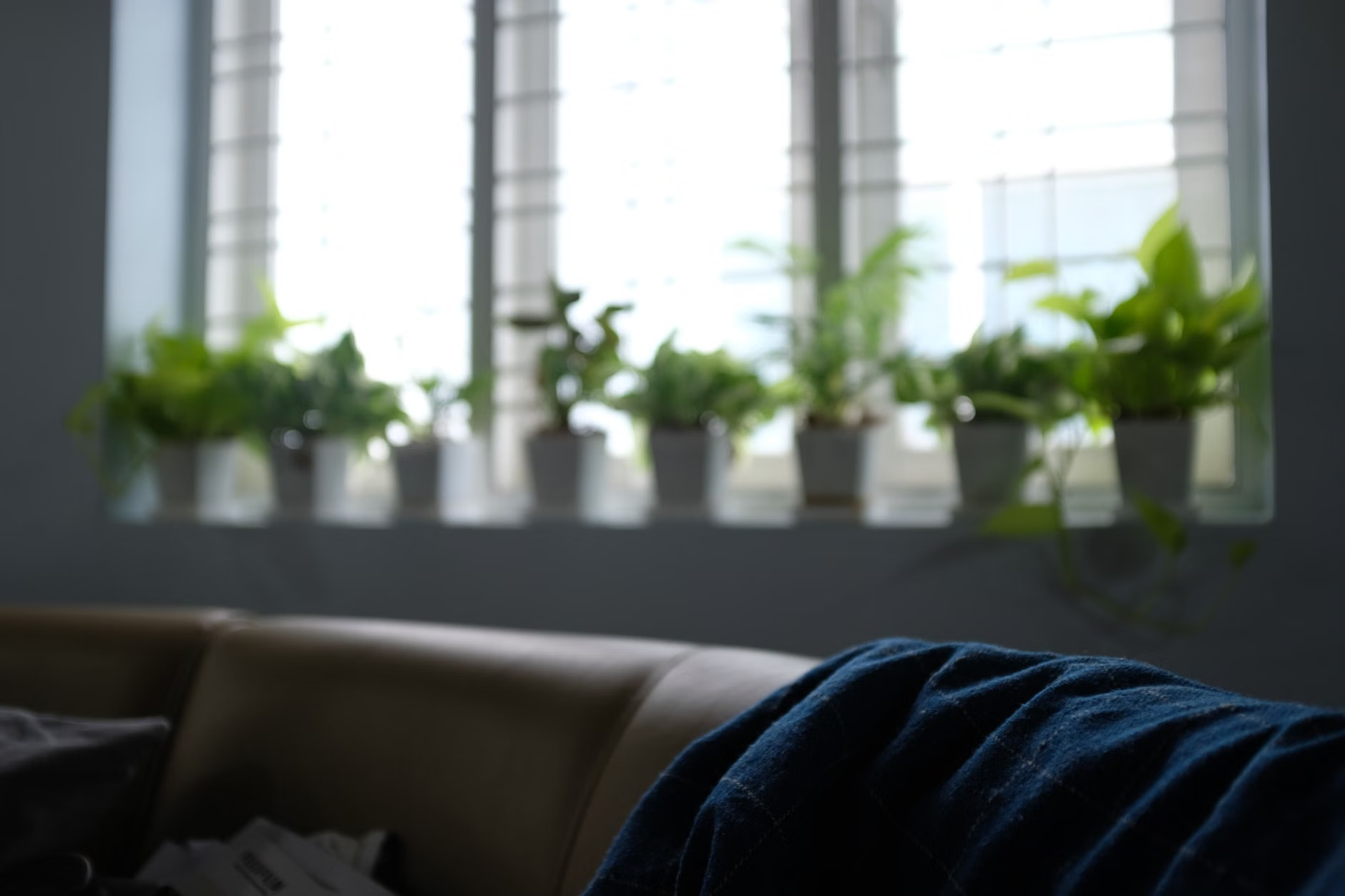
[@growlights] For your shelves: light bars (that go under each shelf) do better than bulbs because light spreads as it travels back and forth slowly w out of each shelf.
For your corners: if you only provide light from one side, your plants will see weak light coming from that way, and grow to that side. You can only minimize this by running lights from at least two directions, like two clamp lights for corner lighting, or a multi-head lamp, or a light bar plus a side light.
Run most indoor lamp setups around 12-14 hours a day, using a timer if you wish, but make sure your plants enjoy at least some kind of real dark at night. 10 hours is about the minimum, and 16 the max unless really instructed to do so. (yardandgarden.extension.iastate.edu)
Forget about “watts.” And be careful with lumens—you may want to gloss over the whole thing entirely as the brand may provide you PPFD/PPF data “to help you select the right lamp for your plants.” (Video you may want to watch maybe after this article) Lumens measures light that the human eyeball can see, not of what your plant can use. (yardandgarden.extension.iastate.edu).
Keeping Safe: Landing fixtures that are safety (UL or ETL) listed. Keep cords/drivers dry. Don’t look right into the eyes. Glare especially can cause blindness and is part of photobiological property issue of lighting. Horticultural lighting illuminate standards are: UL 8800 are described below (webstore.ansi.org).
Shelf and corner lighting quick note:
Shelves simply shade each other from the shadows of overhead lamps trying it in, and of course corner spaces are sprayed with weak daylight. One overhead ‘lamp’ leaves the back half of your shelf dim. This guide is for you to fittingly choose a grow light for tight spaces. The content packed with
terms you will get at least familiar with.- Shelves = a cave: the light from the top shelf partially blocks the shelves below it, so each level needs its own light source (or else the lower levels will stretch).
– Corners = one-sided light: plants lean towards the brightest side, and often will drop leaves on the dark side—especially in winter.
– Depth matters: a light that appears bright in the front is not necessarily going to make it to the back of a deep shelf.
Step 1: Decide what you’re trying to do (keep alive vs grow vs bloom)
A “good” grow light is relative to what you’re trying to do. The light that keeps a pothos happy might be nowhere near enough for herbs or seedlings. One simple way to think about it is your plant’s daily light total (often, known as DLI—Daily Light Integral). DLI is simply the amount of
(yardandgarden.extension.iastate.edu)
| Light goal (DLI category) | What it’s good for (examples) | When you’ll notice the difference |
|---|---|---|
| Low (about 3–6) | Many foliage houseplants | Less leaf drop, less stretching in winter |
| Medium (about 6–10) | Foliage houseplants, some flowering houseplants, cuttings, stronger seedlings (upper end) | Bushier growth, better color, stronger stems |
| High (about 12–16) | Flowering houseplants, succulents, seedlings (lower end), leafy herbs/greens | Tighter growth, more blooms, fewer “leggy” plants |
| Very high (about 18–30) | Herbs, fruiting plants and vegetables indoors | Real harvests and repeat flowering become more realistic |
Those DLI ranges and example plant groups are widely used in extension guidance for indoor supplemental lighting. (yardandgarden.extension.iastate.edu)Step 2: Measure the shelf/corner so you don’t buy the wrong shape of light1. Measure the growing surface: shelf width × shelf depth (or the corner table top).2. Measure vertical clearance: the distance from the shelf surface to the shelf above it (or to the ceiling if it’s a corner floor setup).3. Decide where the fixture can mount: under the shelf, on the shelf side wall, on a nearby wall, or a freestanding stand.4. Plan cord routing: where will the cord and driver (power brick) live
Step 3: Select an appropriate style of fixture for shelves and corners
| Fixture style | Best for | Pros | Cons / watch-outs |
|---|---|---|---|
| Under-shelf light bars | Multi-tier shelves, plant racks | Even coverage; tidy; easy to keep close to plants | You may need one bar per shelf; needs mounting method (screws, adhesive, brackets) |
| LED strip lights (rigid or flexible) | Very shallow shelves, accent + side lighting | Can fit tight edges; good as a “second direction” of light in corners | Not all strips are bright enough for growth; adhesive can fail over time |
| Clamp light + grow bulb | Single plants, small corner setups, side lighting | Aimed light; easy to reposition | Hot spots and shadows; can be harsh glare in living spaces |
| Multi-head gooseneck (table clamp or stand) | Corners, plant stands | Lets you aim multiple angles to reduce one-sided growth | Often overrated brightness; heads may light a small area each |
| Flat panel / board light | Plant tables, wider corner clusters | Good spread when mounted high enough; can cover multiple pots | May not fit under short shelves; can cause glare if not shielded |
| Shop-light style fixture (LED or fluorescent tubes) | Seed starting, utilitarian shelf setups | Cost-effective and widely available; easy to hang — This info applies heavily on distance and tube type |
Step 4: Know the label—without getting lost in the jargon
Much of the confusion is due to terms that are not plant centric. Everything relative to footcandles/lux and lumens is for our vision, not the plant’s. Extension and greenhouse training materials suggest that human-vision dependant light measures may be of little use to the plant.
(greenhouse.hosted.uark.edu</a))|
Grow light numbers: what matters for shelves and corners|On the box|Plain-English meaning|How to use it (simple rule)|
|——|——|—————–|——————|
|PPFD|How much plant-usable light actually reaches a surface (like the top of your plant)|If available, trust this most—especially if there’s a measured “map” at a given distance|PPF |Total plant-usable light the fixture produces|Useful for comparing fixtures, but you still need correct distance/coverage|Lumens / lux|How bright it looks to people|Okay as a rough fallback, but not a plant-perfect measure
(yardandgarden.extension.iastate.edu)|Watts|How much power it uses|Mostly for estimating operating cost—not a reliable brightness indicator|Kelvin (e.g., 5000K)|Color appearance (warm vs cool white)|Choose what looks good in your space; “daylight” ranges are common for plant areas
(marylandgrows.umd.edu)|CRI|How accurate colors look under the light|For living spaces, aim ~80+ so plants and rooms look natural
(marylandgrows.umd.edu)|Coverage (e.g., 2 ft × 2 ft)|The area the brand claims it lights|Treat as a starting guess; verify by observing growth and (ideally) measuring|
A simple way to choose “enough light” for shelves (even if you hate numbers)1. Prioritize adjustability: pick a dimmable fixture or one you can raise/lower easily.
Start closer rather than stronger: shelves often work best with lights mounted closer to the top of the plants (since you’re somewhat limited as to how high you can go up the shelf).
Even coverage first, brightness second: for deep shelves, opt for more bars, not one super bright spotlight.
One light per level = less competition: the higher shelf is going to cast a shadow on the next tier down.
Tip
Practical baseline (common household fixtures): Iowa State Extension talks about example settings with commonly available shop fixtures—a 4-foot LED shop fixture with full spectrum/daylight light located about 18 in from foliage delivering at least 3000 lumens for 14 hours/day, or a 2-bulb T5 high output fluorescent fixture located about 9 in from foliage and light 14 hours/day. Start here and then adjust according to how the plants respond. (yardandgarden.extension.iastate.edu)
If you want one “good enough” brightness target: use DLI categories
If you ever get your hands on a light meter (or lux reading via phone as a rough estimate), you can make this target a little more real with daily light total (DLI). Iowa State Extension describes DLI as the total amount of plant usable light delivered over a day, and describes categories for indoor plants (low, medium, etc). (yardandgarden.extension.iastate.edu)
| DLI category | Approx. DLI | Approx. PPFD needed at 12 hours/day (µmol/m2/s) | Approx. PPFD needed at 14 hours/day (µmol/m2/s) |
|---|---|---|---|
| Low (>3.7) | >12 | 110-135 | 90-110 |
| Medium (3.2-3.7) | 10-12 | 90-110 | 70-90 |
| High (2.8-3.2) | 8-10 | 60-80 | 50-70 |
| Very High (2.4-2.8) | 6-8 | 50-60 | 40-55 |
| Extremely Low (<2.4) | <6 | <50 | <40 |
PPFD needed at 14 hours/day (µmol/m²/s)
Low
3
69
60
Low (top) / Medium (bottom)
6
139
119
Medium (top)
10
231
198
High (top)
16
370
317
Very high (top)
30
694
595
Where those numbers come from: Iowa State Extension includes a simple way to calculate DLI (DLI = PPFD × hours × 0.0036). If you measure the PPFD at the leaf level and then take the daily light total, you can increase or decrease distance, hours, or number of fixtures from there. (yardandgarden.extension.iastate.edu).
Step 5: Place the light correctly on shelves and in corners
For shelves (best practices)
Center the bar(s) over the usable shelf depth—not just overhanging edge.
If the shelf is deeper than about a dinner plate, consider two bars, one toward the front half and one toward the back half.
Mount as close as your plants allow, and pick them up or dim if you see beetling/scorch.
Make sure leaves won’t touch hot fixtures (some bulbs are more risky than others in that regard).
For corners (best practices)
Use two angles of light at least (example: a main light overhead + a smaller side light) to reduce one sided growth.
Rotate weekly if you only have one direction of a main
light.- Try “side help” if only the side facing away from the light looks unhappy: extension guidance specifically mentions that adding reflectors or side lights can help if symptoms present on the side farthest from light. (yardandgarden.extension.iastate.edu)
– Consider a low glare matte white reflector board set behind plants (e.g., foam board) that bounces light back at them.
Step 6: Decide and set a schedule (timers beat willpower)
Most small indoor setups do well with 12–14 hours/day of light. Home setups can run as little as 10 hours but shouldn’t usually exceed 16 hours a day. Keep an uninterrupted dark period at night especially in flowering plants that “know” how long the night is (photoperiod). (yardandgarden.extension.iastate.edu)
- Plug light into simple outlet timer (or smart plug).
- Choose a time period consistent to you (example: 7:00 AM leave on until 9:00 PM for 14 hours).
- Change just one input at a time (distance OR hours OR dimming) and observe plant for 1–2 weeks to see how it responds to the change.
- If you’re trying to encourage blooms, make sure other room lights don’t “interrupt” the dark period.
Color and comfort: choose a light you can live with
If your shelves are in your living room or in your office, you’re going to care about how that light looks. Color temperature (Kelvin) describes whether the white light feels warm (yellowish) or cool (bluish). CRI (color rendering index) describes how natural colors look under the lamp. Extension guidance commonly suggests aiming for CRI in the 80s+ for good color and notes that 5000-6500K is a common “daylight” range
you’ll see in plant setups.(‘Safety checklist (especially important on shelves)’ on marylandgrows.umd.edu )
under-shelf bar
Setup to have light shine on plants in a controlled manner.
- Look for independent safety certification (UL or ETL listing) and follow the manufacturer’s installation and clearance instructions.
- Keep drivers/power bricks ventilated (don’t bury them under pots or fabric).
- Use drip loops and keep plugs away from watering zones; avoid splashing fixtures.
- Control glare: if a light is at eye level on a shelf, add a simple shield or mount it deeper so it doesn’t shine directly into your eyes.
- Be aware that horticultural lighting standards (such as UL 8800) consider photobiological safety and require appropriate caution/warning markings—don’t ignore them. (webstore.ansi.org).
Three shelf-and-corner setups that work (copy/paste ideas)
Setup A: “One bar per shelf” houseplant shelf (clean look)
- Use: LED under-shelf bars, one per level.
- Mount: centered front-to-back (add a second bar if the shelf is deep and the back stays dim).
- Schedule: 12–14 hours/day on a timer. (yardandgarden.extension.iastate.edu).
- Best for: pothos/philodendron types, many foliage plants, “winter support”.
Setup B: Corner plant stand (reduce one-sided growth)
- Use: a main overhead panel OR a multi-head gooseneck aimed down, plus one small side light or reflector board.
- Mount: keep the main light slightly in front of the plant cluster (so the back isn’t shaded by front leaves).
- Maintenance: rotate pots weekly if you still see leaning.
- Best for: mixed houseplants in a dim apartment corner.
Setup C: Seed-starting shelf (utilitarian, very effective)
For seedlings, common extension advice emphasizes that windows usually aren’t enough and that fluorescent “shop light” setups are a reliable way to produce sturdy transplants; incandescent bulbs are poor choices for this purpose. (extension.umd.edu)
Use: shop-light style LED fixture or fluorescent tubes (T5/T8).
Mount: adjustable chains so you can keep the fixture close and move it up as seedlings grow.
Schedule: 14 hours/day is a common home baseline; adjust by growth response. (yardandgarden.extension.iastate.edu)
Best for
: seed trays, cuttings, early spring transplants.Troubleshooting: what your plant is telling you (and the fastest fixes)
Quick diagnosis table for shelf and corner lighting
What you seeMost likely lighting issueFast fix
Long gaps between leaves (stretching), leaning, spindly growthNot enough light intensity at the leavesMove light closer, add a second bar, or increase hours (up to 16 max) (yardandgarden.extension.iastate.edu)Leaf drop on the back side (corner setups)One sided light / deep shade on one sideAdd a side light or reflector board; rotate weekly (yardandgarden.extension.iastate.edu)Bleached patches, crispy/scorched tipsToo intense or too close (or heat stress)Raise/dim the fixture; shorten hours slightlyNo blooms when the plant usually blooms indoorsNot enough total daily light OR dark period being interruptedIncrease daily light total; ensure uninterrupted darkness (yardandgarden.extension.iastate.edu)“Looks bright to me,” but plant isn’t improvingHuman-brightness measures can mislead (lumens/lux/footcandles)Use PPFD/PPF data if available, or measure and adjust based on response (yardandgarden.extension.iastate.edu)
Buying checklist: what to look for before you click “add to cart”
Form factor that matches the space (bar for shelves, multi-angle for corners).
Dimming or multiple brightness levels (very helpful in tight shelves).
Built-in or outlet timer (built-in timer is great; an outlet kind is often a little more reliable.)
Measured PPFD map at some distance (ideally close to maximum recommended value)If no PPFD is indicated, see if they make realistic-looking claims for coverage and look for a well-known, reputable brand with safety certification.Kelvin specs around what makes you comfortable in your living spaces, 80+ CRI if possible. [Source]
Mounting hardware included (screws, brackets, clips) and cord that reaches your outlet cleanly. [FAQ]
FAQ
Q: Am I supposed to need a “full-spectrum” grow light?
A: Not necessarily, but it’s a good option for shelves in your living spaces since it looks like lamps burning normal all white kind of light. Many of their examples for general indoor supplemental lighting rely upon “daylight/full-spectrum” lamps as their precedent case. (yardandgarden.extension.iastate.edu
Q: How many hours a day should I run a grow light on my plant shelf?
A: Target hours are generally 12-14 hours per day, so many home set-ups can go 10 hours without wilting and most shouldn’t exceed 16 hours per day, also make sure you leave an uninterrupted dark period. [Source] yardandgarden.extension.iastate.edu
Q: Can I use ordinary LED shop lights instead of a grow light?
A: Most of the time yes. They include in their guidance a set of example set-ups using “cheap” shop fixtures (LED or fluorescent) and then adjusting the distance/hours to results. (yardandgarden.extension.iastate.edu,
Q: Why are my plants getting leggy when the light looks lights out bright?
A: Difference between light to your eyes (lumens/lux, footcandles not usable by your plants. Measures aimed more at the plants, PPF/PPFD will provide more helpful information and placement distance matters a lot. (yardandgarden.extension.iastate.edu
Q: What’s the easiest indicator that my shelf light is working?
A: Use a timer and observe for 1-2 weeks: new leaves should be closer together (less stretching). Leaning should improve and color should be more vivid. If only the far or back side is the only struggling (common in corners) add a reflector or side light. (yardandgarden.extension.iastate.edu
Q: Are grow lights safe to look at?
A: No source of intense light should be stared into, control shock effect/glare particularly at eye level on shelves…they quote some standards concerning horticultural lighting on their site and include state and even university sites on the level of third-party testing…they also address photobiological safety, require some marks on the appliance, warning…they recommend that consumers take the markings seriously and read the instructions. (webstore.ansi.org). [Source][17]: Iowa State University Extension and Outreach – Important Considerations for Providing Supplemental Light to Indoor ills [Source][18]: Iowa State University Extension and Outreach – How to Determine How Much Supplemental Light to Provide For Indoor Plants [Source][19]: Iowa State University Extension and Outreach – Growing Indoor Plants Under Supplemental Lights [Source][20]: University of Maryland Extension – Grow Lights for Starting Seeds Indoors [source][21]: Maryland Grows (University of Maryland Extension) – Fine-tuning your indoor plant lighting choices [source][22]: Michigan State University Extension – Daily Light Integral defined (Floriculture & Greenhouse Crop Production) [source][23]: University of Arkansas – Greenhouse Course Unit 04: Lighting [source][24]: ANSI Webstore – UL 8800: Standard for Horticultural Lighting Equipment And Systems (listing page) [source][25]: Standards Council of Canada – ANSI/CAN/UL 8800:2025 (listing page)