Your Apartment Is Killing Your Plants: The Brutal Truth About Low Light and Bad Placement
If your “low-light” plants keep yellowing, stretching, or dropping leaves, the problem is usually not your watering schedule—it’s your light reality. Here’s how to measure what your apartment actually provides, place any…
Your place isn’t “low light.” It’s a “not enough light for photosynthesis to exceed decline” place. And when the plant can’t meet its energy bills, no amount of perfect watering will save it—over time it will “cash out” in yellowing, long bare stems, and a general air of failure.
The good news is, light problems are easily fixed—once you stop making placement decisions like an interior designer and start treating it like a real growing condition.
“No, stop bluffing! Out with it! What’s the terrible truth about low light?”
Well, rather than knowing about light they’re working in, most labels and online care guides refer vaguely to “bright indirect light”, “low light”, etc, which is useful for the marketer but unhelpful in deciding placement. A more useful shorthand is to think of plants in terms of their light intensity numbers.
TL;DR — Light intensity (above an objective threshold) = plants being able to grow well enough. Plants in human-bright rooms that are still plant-dark. Ambient room light can be under 50 fc. Low light doesn’t = no-window corner, but is usually a few fistfuls of fc lower than that. It’s the absolute distance from a window that matters most—light intensity drops fast as you retreat back into a room. There’s no need to guess. Measure plant spots with a cheap light meter or phone app then match the plant to those numbers. If you can’t move the plant closer then use a grow light (on a timer and not 24/7). The University of Maryland Extension cautions that indoor plants are often labelled as low, medium, or high light, and gives example fc ranges for each. (extension.umd.edu)
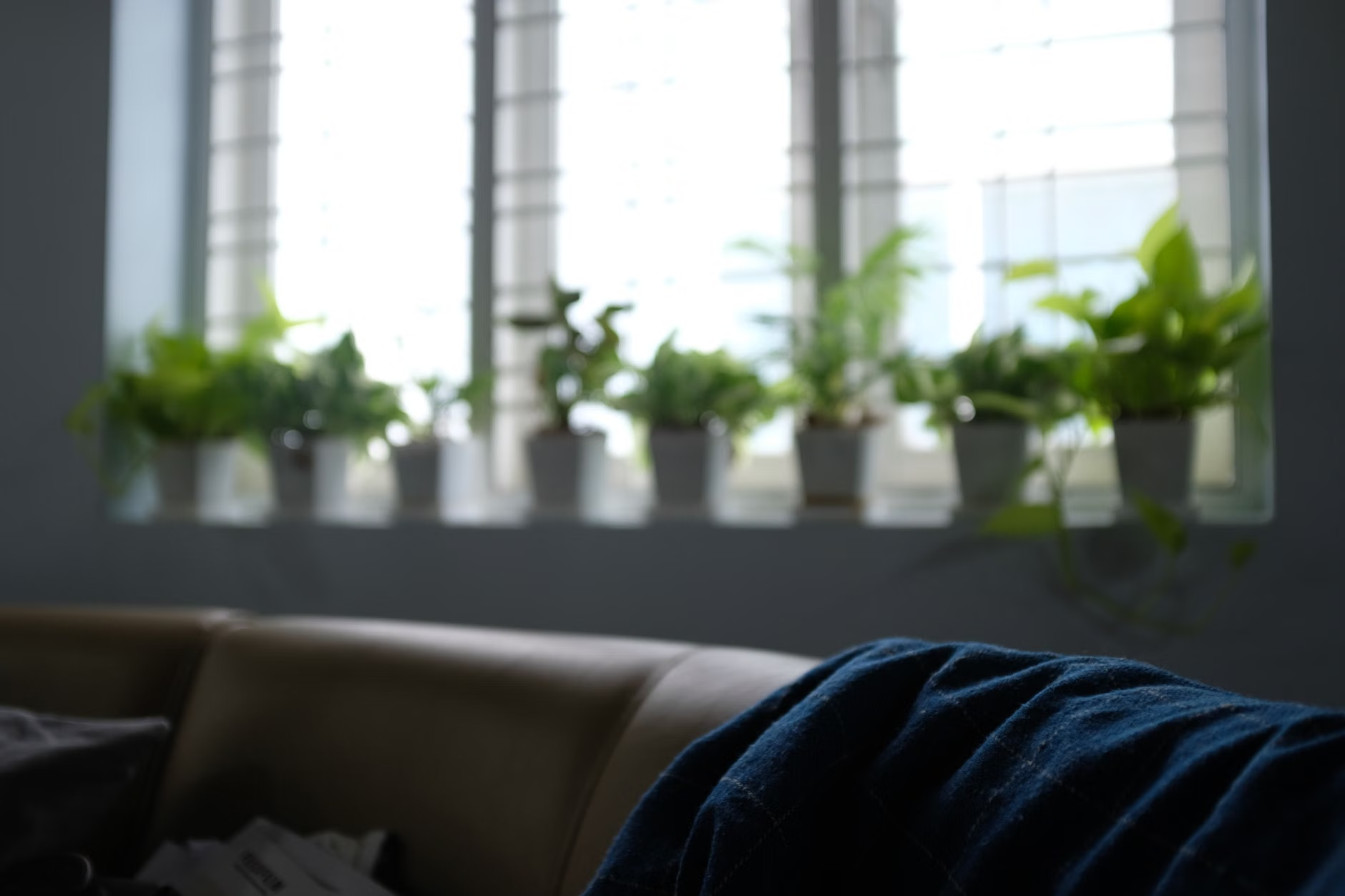
Here’s the part that surprises most people: a room can look perfectly bright to you and still be dim for plants. University of Maryland Extension educators point out that our eyes adjust quickly, so we’re poor judges of actual light intensity. (marylandgrows.umd.edu)
Why bad placement kills plants (even when you water “correctly”)
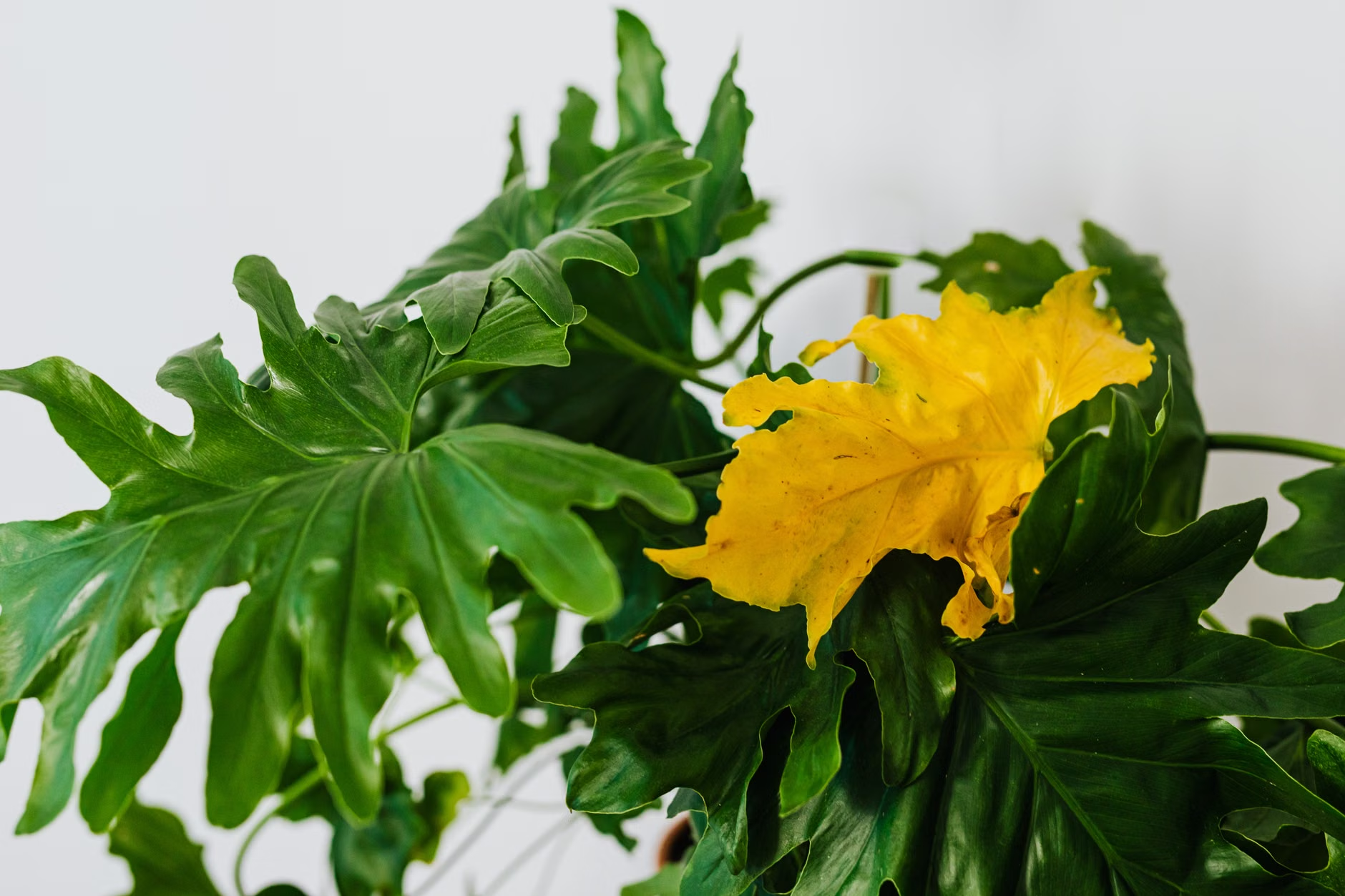
Light is fuel. Inadequate light means inadequate photosynthesis—so the plant has less energy to grow roots, replace leaves, resist pests, and recover from normal mistakes (like one slightly-too-wet watering). The University of Maryland Extension lists classic “too little light” symptoms: spindly/leggy growth, fading leaf color, reduced flowering, poor growth, and leaning toward the light. (extension.umd.edu)
University of Missouri Extension adds more: long internodes (big gaps between leaves), smaller-than-normal leaves, pale foliage, and lower leaves yellowing and dropping can all show up when a plant is otherwise healthy but under-lit. (extension.missouri.edu)
The placement mistakes that quietly wreck houseplants
Mistake #1: “A few feet from the window counts as bright indirect light.” It might be indirect, but it may not be bright. Light intensity drops off drastically with distance from the source. (extension.umd.edu)
Even with “low-light” plants, you may not have enough light far back in the room. University of Missouri Extension explains that even low-light plants won’t get enough light more than ~10 feet from an average window. (extension.missouri.edu)
Here’s how to fix it:
- Move the plant as close to the window as you can tolerate from an aesthetic standpoint. Watch for leaf scorch (too much direct sun)—don’t assume that it needs to be “protected.”
- If it must go far back in the room, treat a grow light as part of the décor—because of course it’s part of the plant’s life-support system.
Mistake #2: “Low light” = “no-window corner”
This is the big lie that leads to slow-motion plant death. Colorado State University Extension (PlantTalk Colorado) describes low light as a range and warns few plants tolerate light levels below 50 foot-candles. (planttalk.colostate.edu)
Compared, educators with University of Maryland Extension note that ambient light in a residential room may be less than 50 fc. (marylandgrows.umd.edu)
Mistake #3: Putting plants against the glass (or over a vent/radiator)
The window is the brightest spot, but touching the glass can expose leaves to winter cold or summer heat extremes. Colorado State University Extension suggests not placing leaves touching the glass. (planttalk.colostate.edu) A couple inches of clearance will help; a plant stand or riser so that the plant is close but not touching the glass can work. Avoid harsh blasts from HVAC vents and radiators; it may be less stressful to move a plant 12-24” to the side to avoid the drafts, even if that means it gets a little less light (especially if the plant is still close to the window).
Mistake #4: Ignoring the season (your winter setup is not your summer setup)
Nebraska Extension shares that windows do not present the same conditions year round, and a plant growing well in “a particular window in summer will not necessarily do so in winter”. (lancaster.unl.edu) University of Missouri Extension notes that in winter, all houseplants will benefit from the light of a south window (though may need some grass shade or other protective measures against strong light, for a few times of year). (extension.missouri.edu)
Step-by-step: audit your apartment’s light in 15 minutes
Don’t guess. Measure. Colorado State suggests a simple handheld light meter or your phone. (planttalk.colostate.edu) University of Tennessee Extension adds that a footcandle meter or phone app are common, inexpensive tools for assessing light conditions inside. (utia.tennessee.edu)
- Pick a normal day. Don’t measure something crazy (like a storm, or with your blackout curtains closed unless that’s just typical for you).
- Measure at the height of the plant. Don’t stand on the floor or up at your eye level to measure the light. Hold the meter/phone where the leaves actually are. Take readings in 3 places: (1) right at the window the plant is at, (2) where it usually is, (3) where you wish you could put it (like that cute shelf).
- Take readings at 2 times: late morning and mid-afternoon. (If you’re serious, repeat the same spots in winter and summer.)
- Write the numbers down and label the spot. Light is a map, not a feeling.
- Match plants to the spot—not the other way around. Use the fc ranges below as a starting point.
Window-direction cheat sheet (typical U.S. apartment, Northern Hemisphere)
In the United States, south-facing windows usually provide the strongest indoor daylight. Nebraska Extension gives a useful rule of thumb, that if south exposure is 100% intensity, east and west are about 60% and north about 20%, all else being equal. (lancaster.unl.edu) Here are some suggestions by general location:
| Window / location | What the light is usually like | Plants that tend to cope better | Placement notes that prevent slow decline |
|---|---|---|---|
| South-facing window | Brightest and longest duration of daylight | High-light lovers (succulents/cacti; many flowering plants) and medium-light foliage plants if you control direct sun | Start close, then back off if you see bleaching or crispy patches. In winter, many plants benefit from this window. (extension.missouri.edu) |
| East-facing window | Gentler morning sun; often a great “middle ground” | Many foliage houseplants; plants that dislike harsh afternoon sun | If a plant is stretching here, it likely needs to be closer to the glass or supplemented in winter. (lancaster.unl.edu) |
| West-facing window | Strong afternoon sun; can run warmer | Plants that can handle brighter light (with acclimation) | Watch heat + dry air. A sheer curtain can reduce leaf scorch without turning it into “low light.” |
| North-facing window | Lowest light through the year | True low-light-tolerant plants | Low light still usually means “near a window,” not “across the room.” (planttalk.colostate.edu) |
| Interior (no window) | Often plant-dark for most species | None long-term without dedicated grow lights | If it measures under ~50 fc most of the day, treat it as a grow-light zone. (marylandgrows.umd.edu) |
Use numbers: simple footcandle targets for real-life placement
Different extensions and references may use slightly different cutoffs, but the idea is consistent: pick a plant that matches the light you actually have. University of Maryland Extension provides a clear, beginner-friendly breakdown (with examples): low light around 25–100 fc, medium-bright around 100–500 fc, and high light around 500–1000 fc (with direct indoor sunlight over 1000 fc). (extension.umd.edu)
| What you measure (fc) | What it usually means in an apartment | What to expect | What to do if you want more growth |
|---|---|---|---|
| Under ~50 fc | Deep interior / mostly artificial ambient lighting | Most plants slowly decline; even “low-light plants” often just endure | Add a grow light or move close to a window. (planttalk.colostate.edu) |
| ~25–100 fc | North window area or dim room edges | Slow growth; fewer new leaves; foliage may be smaller | Keep the plant close to the window; keep watering conservative. (extension.umd.edu) |
| ~100–500 fc | Typical east/west window zone (or a bright room close to a window) | Steady foliage growth for many common houseplants | Rotate weekly; consider a small grow light in winter if growth stalls. Placement: 3,500 fc to 2,000 fc (extension.umd.edu) |
| 500–1000 fc | Bright south window zone (or a strong west window) | Better structure, better color, better chance of blooms | Watch for scorch; back off with a sheer curtain or a little distance. (extension.umd.edu) |
Placement rules that actually work (and why)
- Rule 1: Start as close to the window as possible, then adjust back only if you see damage. Light intensity decreases rapidly with distance. (extension.umd.edu)
- Rule 2: Don’t hide low-light plants. Low light is still light—usually near a window—not the center of the room. (planttalk.colostate.edu)
- Rule 3: Measure “at leaf level.” A shelf can look bright while the plant itself sits in shade cast by the shelf above.
- Rule 4: Rotate plants. If light comes from one direction, plants will lean; rotation reduces one-sided growth. (extension.umd.edu)
- Rule 5: Clean what blocks light. Window grime + dusty leaves = less light interception. (University of Tennessee Extension specifically suggests keeping leaves clean to increase light interception.) (utia.tennessee.edu)
If you can’t move it: how to use grow lights without frying your plants (or your sleep)
When natural indoor light is limiting growth, adding supplemental lighting can solve the problem. Nebraska Extension notes that plants that barely existed with natural light can thrive when provided 12 to 16 hours daily of supplemental light. (lancaster.unl.edu)
Also, plants still need darkness. University of Maryland Extension recommends lighting most plants no more than 16 hours per day in total (especially when combining artificial with natural light). (extension.umd.edu)
- Identify the objective: (a) keeping plants alive in a windowless room , or (b) pushing growth and better leaf size . Your goal will set the brightness and location.
- Use a timer to be precise. Regularity is better than “whenever I remember.” (And it protects you from accidentally running the light 20 hours a day.)
- Place the light close enough for it to matter. With many popular arrangements, inches matter more than you’d think. University of Missouri Extension points out that under fluorescent light, many plants should be positioned about 6-12 inches from the light, since intensity drops off rapidly with distance. (extension.missouri.edu)
- Double-check your meter when you set it up. With the grow light on, lift it to leaf height and adjust the height until you read in your target range.
- Watch the plant for two weeks and adjust. Too much light shows as bleaching, crispy patches, or suddenly droopy leaves even when the soil feels damp. Too little light might show as leaf stretching and weak new growth. (extension.umd.edu)
Plant choices for light stingy homes (and really, why does “tolerate” so much?)
If a plant “tolerates” low light, it may still be growing slowly, dropping older leaves, or losing variegation. But you absolutely can build a plant collection that suits a dimmer apartment if you stop trying to make high-light plants behave like low-light ones.
If you want an uncomplicated starter list, University of Maryland Extension provides examples by light level (low: ZZ plant, snake plant, cast iron plant, peace lily; medium: Chinese evergreen, rubber plant, dracaena, African violet; high: croton, hibiscus, jade plant, hoya; direct indoor sun: citrus, succulents/cacti, gardenia). (extension.umd.edu)
| Your measured spot | Try these types first | Avoid these in that spot (unless you add a grow light) |
|---|---|---|
| ~25–100 fc (true low light) | ZZ plant, snake plant, cast iron plant, peace lily | Most succulents/cacti, citrus, gardenia, many flowering plants that need higher intensity |
| ~100–500 fc (medium-bright) | Chinese evergreen, rubber plant, dracaena, African violet | Citrus and many succulents if you want strong growth and compact form |
| ~500–1000 fc (high light) | Jade plant, hoya, hibiscus, croton (with acclimation) | Low-light plants placed right at the glass in peak summer sun (risk of scorch without acclimation) |
Common low-light care mistakes (that are actually placement mistakes)
- Overwatering in dim light: Where light is low, growth is slower, and that spot uses less water. The same water schedule that really worked in your sunny window may get roots in trouble in a darker place.
- Assuming “it gets light all day” because you’re home all day: An extension of time doesn’t remedy a low intensity. (You can have 12 hours of dimness.) (extension.umd.edu)
- Putting a plant where it looks best and hoping it will adjust: Plants adjust a bit, but they aren’t going to photosynthesize if you don’t convince them they are getting enough photons.
- Purchasing higher variegation plants for low light: Variegation often requires more light, and in low light new growth can exhibit decreased size, increased chlorophyll density, and lower density overall. (extension.umd.edu)
- Never re-checking light after moving furniture, getting curtains, or changing window coverings: U Maryland Extension points out curtains, screening, and even cleanliness are going to affect intensity. (extension.umd.edu)
How to confirm your new space is sufficient- simple 4 week test
Don’t trust your hope. Run a little observable experiment to confirm you didn’t just ignore the real issue.
- Week 0, get a picture at the same angle. Note the reading (fc) at the level of the leaves, and note any existing issues with the plant (yellow leaves, drops leaves, leggy, etc.)
- Weeks 1-2, start looking for ‘changes in behavior’—reduced leaning towards the light, stems starting to firm up more, no fresh yellowing in on the latest growth bars a leaf or two cuz that is bound to happen etc, and dried down cotton candy faster in the pot.
- Weeks 3-4, start looking for “good new growth”—shorter internodes (less stretch), larger leaf size, stronger color. These are ‘traditional signs’ you got some light improvement. (extension.umd.edu)
Adjust: If it keeps stretching, aim for more light (closer to window or a stronger/closer grow light). If it gets scorched, reduce the direct sun (sheer curtain or a tad of distance) while keeping intensity at least reasonably high.
FAQ
Can any houseplant live in a windowless room with normal lamps?
Not usually for long. Normal ambient residential light can be <50 fc, which is less than many plants tolerate long term. (marylandgrows.umd.edu) If you want plants in a windowless room, plan on a dedicated grow light on a timer.
What does “bright indirect light” actually mean in an apartment?
It should mean high intensity without direct sun hitting the leaves—but in apartments can often get misused to mean any spot that happens to be minding its own business well out of the way of the window. Measuring at leaf level is the quickest way to stop guessing. (marylandgrows.umd.edu)
Why is my plant leaning hard to one side?
Chasing light. Same as with tall, stretched growth. Too little light and one-direction light both cause leaning. Rotate regularly and increase intensity (usually by moving closer to window, or supplementing). (extension.umd.edu)
How many hours should I run a grow light?
A common starting point is 12-16 hours daily for the supplemental light. Nebraska Extension notes plants can thrive with 12-16 hours of supplemental light. (lancaster.unl.edu) Also, most plants should not be lit for more than 16 hours a day in total. (extension.umd.edu)
How close should the grow light be to the plant?
Close enough that the plant is actually getting the intensity you need at the leaf level. In fluorescent setups, University of Missouri Extension notes that most plants do best with the tips about 6-12 inches away from the light source since intensity drops so quickly away from the source. (extension.missouri.edu) With LEDs, follow manufacturer guideline and verify with your meter.